“Hang on to your hat. Hang on to your hope. And wind the clock, for tomorrow is another day.”
2026 Q1 Newsletter
By Jason Lesh, Managing Principal

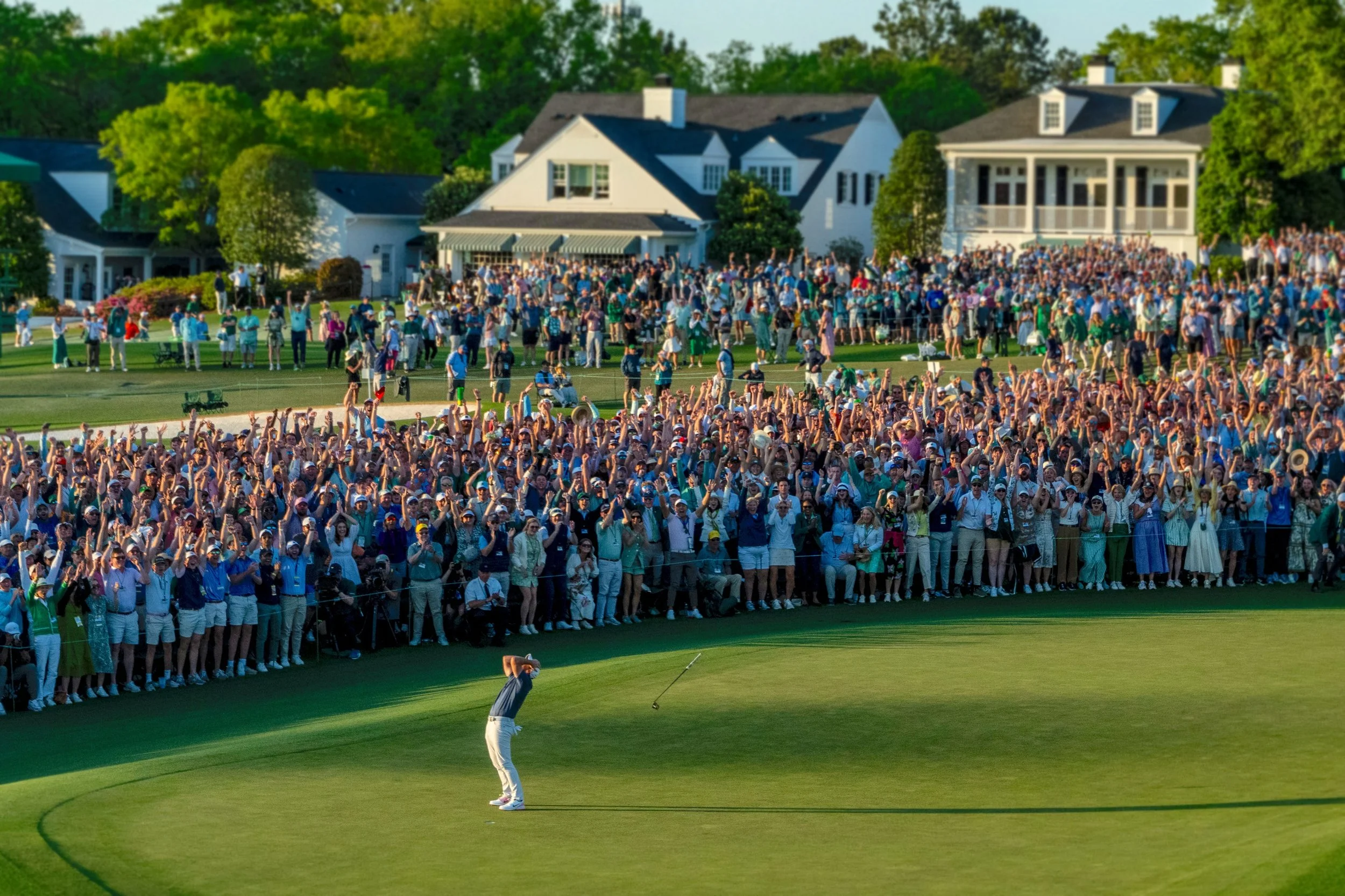
It’s a struggle picking the entry point for this quarter’s commentary: politics, the global economy, or the irony of current blockades in the Strait of Hormuz? We could even discuss the role of the Pope. But instead, I’d like to reference golf. Because everyone enjoys talking golf - and specifically, The Masters.
The Masters (having just concluded on Sunday) is one of four major golf tournaments held each year. Unlike the others, it is played at the same place every spring: Augusta National Golf Club in Augusta, Georgia. In a world of short attention spans, fleeting fads, and the relentless drive to maximize immediate profits, The Masters is an incredible outlier.
No cell phones are allowed on the property; the patrons are incredibly present. Scoreboards are operated by hand and look the same today as they did in 1946. There are no corporate hospitality suites around the greens, no sponsor signage, and sandwiches are still $1.50. If they were trying to maximize short-term profit, they have surely failed.
What they have succeeded at is creating something timeless and scarce. Their decisions are not made for tomorrow, but for 20, 50, and 100 years in the future. It is the reason why The Masters is revered as the best sporting event and brand in the world.
The decisions we make managing your investments follow that same philosophy.
We have been, and continue to be, value investors. We make decisions based on long-term trends rather than tweets and passing whims. Whether oil is up or down tomorrow does not interest us; however, knowing that raw materials and commodities are becoming scarcer and more necessary allows us to position portfolios to perform well for decades. The volatility that scares most people allows us to buy at a discount, reduce risk, and prepare for a future with better returns.
In Nick’s commentary, you will see this thesis in action. Our strategy remains focused on navigating the "Great Rotation" by shifting away from overextended digital assets and toward the "3D world" of atoms, energy, and infrastructure - unloved and undervalued sectors where scarcity is now driving long-term value.
I want to close with a thought from E.B. White, the legendary American author of Charlotte’s Web and The Elements of Style. In 1973, during a particularly turbulent time in history, White wrote a letter to a man who had lost his peace of mind. He reminded him that while the world may seem in disarray, there is a quiet power in sticking to one's discipline. He wrote:
"Hang on to your hat. Hang on to your hope. And wind the clock, for tomorrow is another day."
E.B. White
We see our job as "winding the clock." While the "winds" of the global economy may blow, we remain focused on the steady, disciplined work of managing our clients’ capital with a 100-year perspective. We are sleeping well knowing their investments are positioned for the long haul, and we hope this commentary allows them to do the same.
Warmly,

As we transition from the first quarter to the second quarter, the headlines have been dominated by the geopolitical tensions and the emotional weight of the ongoing U.S. conflict in Iran. It is human nature to feel a sense of unease when the evening news is filled with such uncertainty. However, as stewards of our clients’ capital, our mandate is to look past the immediate "noise" and focus on the structural shifts occurring beneath the surface of the global economy.
We don’t manage portfolios based on headlines; we manage them based on value. While the geopolitical situation is very serious, its long-term impact on business valuations is often decoupled from the visceral reaction of the daily ticker. Instead, we prefer to lean on the long-term secular changes we are seeing.
We are currently witnessing what John Mihaljevic has described as the "Great Rotation." For much of the last two decades, market leadership was concentrated in a handful of "mega-cap" technology names. The two-dimensional (2D) realm of screens, software, and digital engagement has captured the lion’s share of global capital by offering near-infinite scalability and near-zero marginal costs. These companies’ valuations have been driven more by momentum and cheap credit than by traditional metrics of cash flow.
This era is ending.
The Great Rotation is the migration of capital away from these overextended "glamour" stocks and toward the "unloved, unknown, and undervalued" sectors of the 3D market.
We stand at the cusp of a major capital regime change…the three-dimensional (3D) world of atoms, energy, metals, and infrastructure is entering an era of scarcity. The “playbook of the last thirty years is broken,” according to Will Thomson of Massif Capital…2026 may be retrospectively identified as the pivot point where antifragility shifted from the owner of the software company to the owner of the copper mine.
We have been preparing for this environment for several years, emphasizing the scarcity of commodities, international markets and the small and micro-cap space. These asset classes have a relative value that hasn't been this wide in more than 25 years.
In this environment, many investors are spooked by the volatility of equities, especially those of the 3D economy. But, as we often discuss, volatility is not risk. The best way to reduce the risk of jeopardizing retirement is to own a variegated portfolio of scarce assets. Scarce assets will become more valuable over time.
While the 2D world drowns in abundance, 3D remains constrained. The physical domain is defined by friction, and that friction is now the source of value…The 3D world has been in a bear market for most of the last decade. Capital has fled the sector since the commodity peak in 2011, resulting in massive underinvestment in productive capacity…we are moving from an era of globalization and abundant resources to an era of “unwinding” interdependency and resource nationalism.
Just as the 2D world has consumed all of the excess capacity of the 3D world, The 2D world, driven by AI, is inflecting upward and supply from the 3D world is significantly constrained.
To be clear, the 2D world has become dependent on the 3D world. You can’t have AI, robotics and technological advancement in general without power, copper, magnets, etc. This is at a time where we have significantly underinvested in the 3D world. Materials have become a mere 1.7% of the S&P 500 and energy has become 2.9% of the S&P 500 (formerly 6% and 12% respectively in 1990). Meanwhile IT has become 34% of the S&P 500.
Looking Ahead
Our philosophy remains rooted in principles: Rigorous fundamental analysis, a long-term time horizon, and the courage to be contrarian. The “Great Rotation” favors the prepared. While the broader indices may struggle as the air comes out of the "Magnificent Seven" bubble, the opportunities we seek out are positioned to thrive over long periods. We are not buying "the market" we are buying specific, high-quality, scarce opportunities, like the 3D economy. The market has mispriced this due to short-term fears. The fundamentals will catch up.
The conflict in Iran and the resulting fluctuations create a fog that blinds many investors to the underlying opportunity. Our job is to see through that fog. We remain committed to staying the course, ignoring the crowd, and focusing on the compounding of wealth over years, not weeks. The “Great Rotation” is not a single event, but a multi-year process.
We thank our clients for their continued trust in us. We are honored to steward their hard-earned savings.
